WHAT'S IN A NAME?
The name Dunstable, or "Dunstaple" as it was usually written in the past, is derived from two Anglo - Saxon words, "Dun" meaning a hill or down and "Staple" meaning market. So Dunstable is quite literally "The market by the Downs". The modern town was established by Henry I some time before 1109 on the site of a former Roman posting station. The King later regularised the markets which were being held at the crossroads of Watling Street and Icknield Way and granted local control over them to the Priory of St Peter in the town's first Charter in 1131.
These events are depicted in the town's armorial bearings shown here
which evolved from an original coat of arms granted in 1135 to Dunstable Priory. The present-day version was adopted by the Borough Council in 1865 together with special privilages granted to it by a Royal Charter of Queen Victoria in 1864. These special rights were passed on to Dunstable Town Council in 1985.
The extended version of the arms was registered with the College of Arms on 5th June 1865. The full heraldic description is "Argent, a Pile Stable, charged with Ring and Staple, on Bordure, Engralid of the Third". The Latin inscription means "Justice for All".
If you prefer a more creative tale about the origins of the town name, consider the colourful but unproven legend of Dun The Robber. Some time before Henry I established the new town on the crossroads the area was plagued by a band of robbers led by one Dun or Dunna or Dunning. To tempt them into the open the King had a stake planted at the crossroads and fixed to it his gold ring, held in place by a staple as a challenge to Dun to steal it. Dun accomplished this successfully despite the King's guard but, after further adventures, was eventually captured and executed. The town which was established following these events was named after "Dun's Staple"
Dunstable's destiny was, for all intents and purposes, established when the Romans dissected Britain East-to-West and North-to-South with major arterial 'motorways'.
The resulting crossroads of Watling Street and the prehistoric Icknield Way created a natural communications hub which has since grown into
the town we see today which combines the benefits of a basically rural environment supported by significant industrial and commercial development.
That there was human activity in the region prior to this period is beyond doubt, with a rich heritage extending to Neolithic times and beyond, largely hidden beneath the Chiltern Hills and surrounding areas.
The transition from a strategic map reference to a modern town with character has been far from dull, with significant contributions from the Monarchy, the Church, Industrialists and the country's leading cultural heavyweights who have all left their mark.

Dunstable's Market Charter granted by Henry I in the early part of the 12th Century.

Dunstable Market |
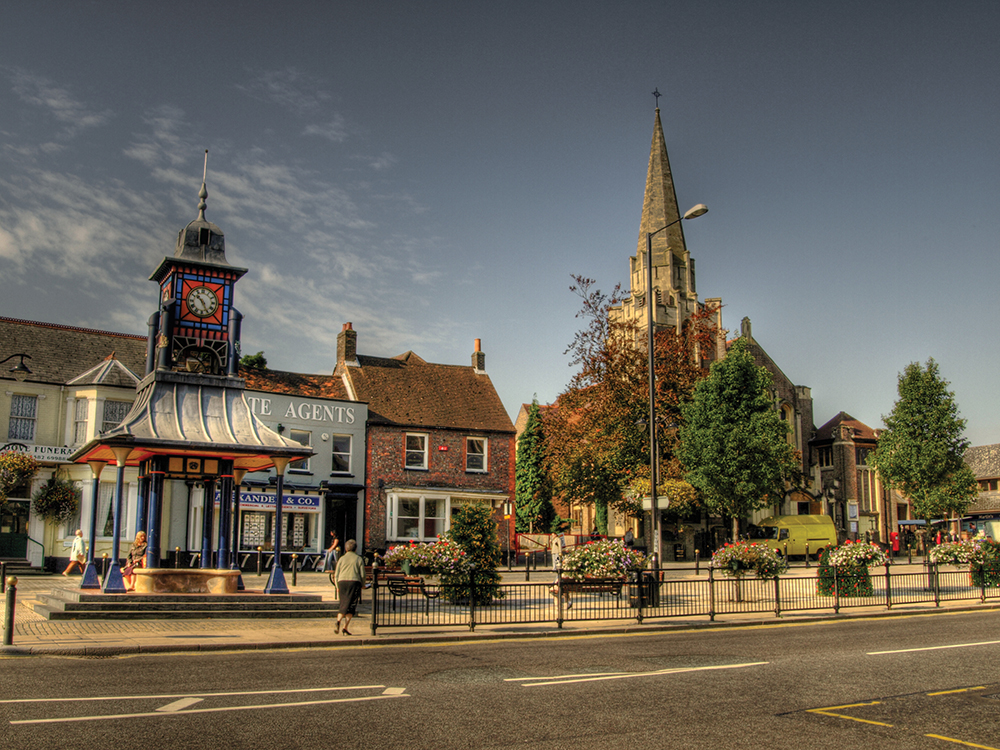
Dunstable has retained its identity as a market town, the Royal Charter having been granted in 1131 by Henry I. Upwards of 35,000 people now live within the town's boundaries defined generally by the M1 Motorway on its eastern gateway, the Chilterns to the west, St Albans and the London approaches to the south and the relatively new City of Milton Keynes to the north.
In addition to being well served by major road and motorway links, the Town benefits from national rail and international air services accessible in Luton, approximately five miles away from the Dunstable town centre |