
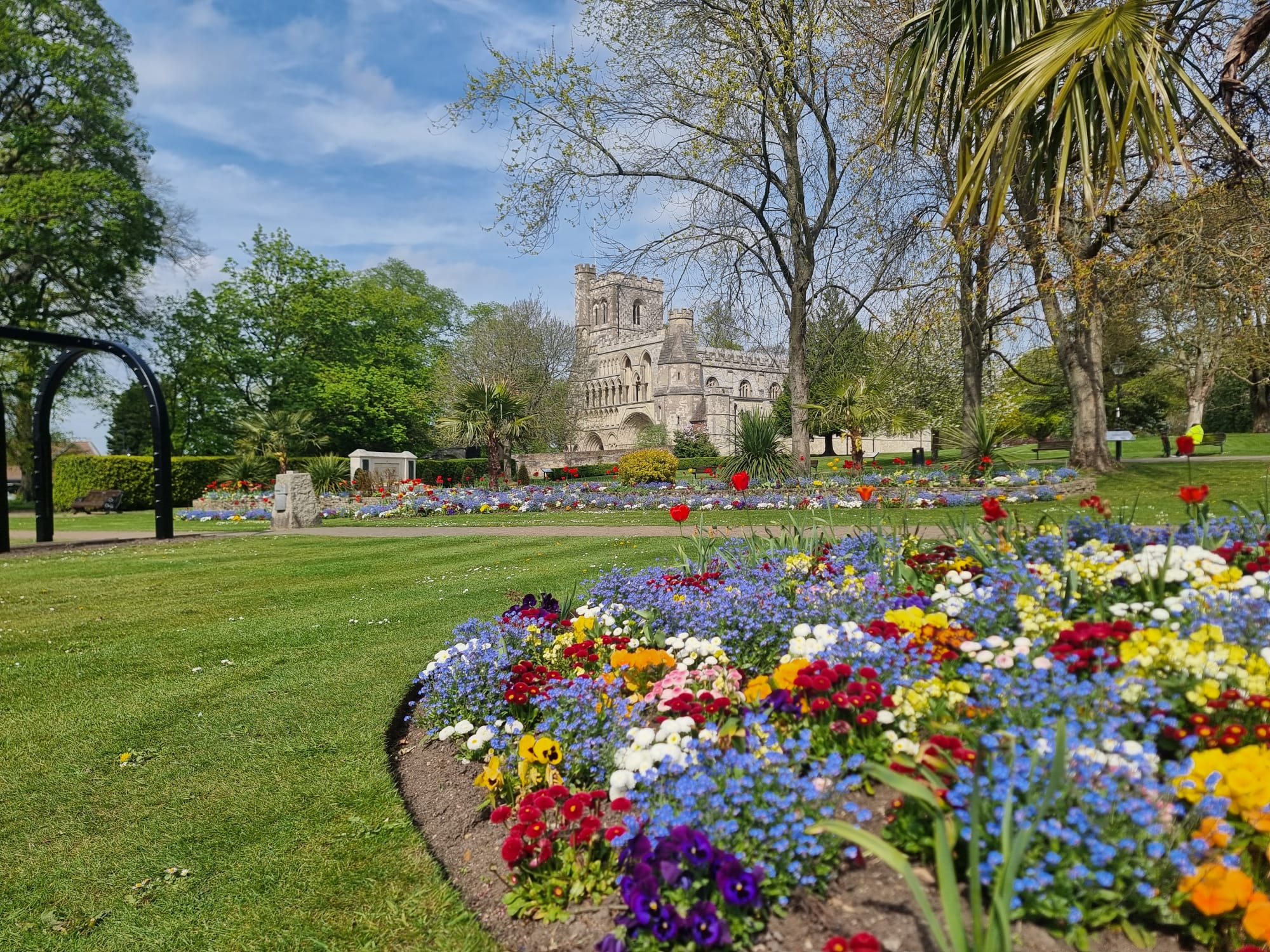
The gardens and grounds are a Listed Scheduled Monument and still hold much of their original charm, including the Medieval Priory Gateway and the Physic Garden. White lines on the ground show where the old Priory buildings once were, with plaques marking the names of the rooms, poignant reminders of Dunstable’s rich history.
Dunstable Town Council manages and maintains Priory Gardens to a high standard and works in association with Friends of Priory House and Gardens. The Council is proud to have been awarded Green Heritage Status for the site and takes great care in ensuring that the gardens remain an attractive, well-managed, safe and sustainable open space. Visitors can enjoy the tranquil surroundings of towering trees, lawned areas and colourful seasonal flower beds.


Medieval Physic Garden
Tucked away in the heart of Dunstable, the Medieval Physic Garden offers a unique glimpse into the healing traditions of the Middle Ages. Carefully designed to reflect the types of plants used by monks, apothecaries, and herbalists of the time, this tranquil space showcases a diverse array of medicinal herbs once believed to cure ailments and promote well-being. Visitors can explore the neatly arranged beds filled with lavender, sage, comfrey, and other historic remedies, each thoughtfully labelled with its traditional uses. Perfect for history enthusiasts and garden lovers alike, the Medieval Physic Garden in Dunstable is a peaceful, educational retreat that connects modern-day visitors with the herbal wisdom of the past.
War Memorial
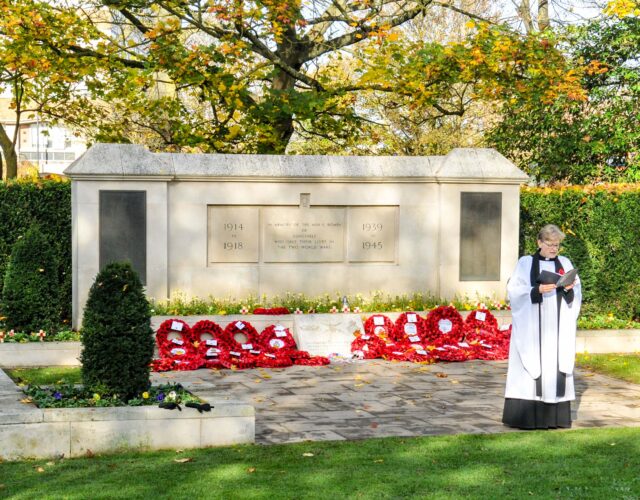
The Dunstable War Memorial stands as a poignant tribute to the local men and women who sacrificed their lives during the First and Second World Wars. Originally unveiled in 1922 by the Duke of Bedford, the memorial features a central limestone tablet flanked by bronze plaques inscribed with the names of 333 fallen service members—200 from World War I and 133 from World War II.
Over the years, the memorial has undergone significant refurbishments, including a major restoration in 1998–99 and an update in 2018 to add 50 previously unlisted names, thanks to the efforts of local historians and the Dunstable and Menen Rotary Clubs. Today, it remains a focal point for annual Remembrance Day services, where the community gathers to honour the fallen. The memorial’s enduring presence underscores Dunstable’s commitment to remembering its heroes and preserving their legacy for future generations.
Priory Pergola
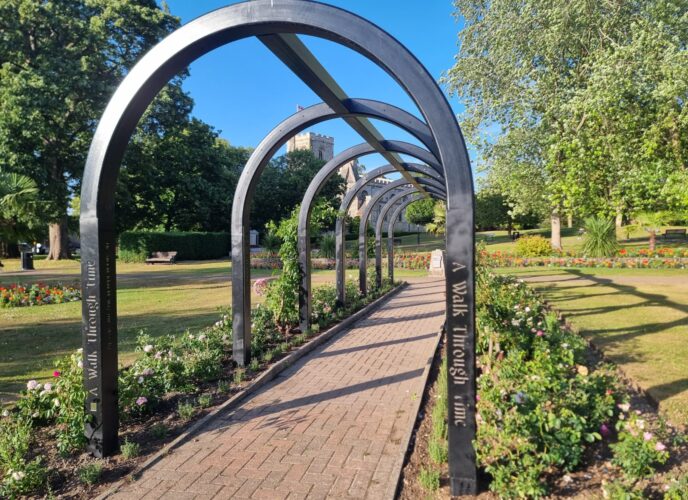
The pergola is a striking black metal structure, gracefully arching to create a welcoming focal point in Priory Gardens. Inspired by the architectural features of nearby historic buildings, its design echoes the arches of Priory Church and the elegant windows of Priory House. More than just an ornamental feature, the pergola tells the story of the area’s rich past—each post marking a significant moment in time, from prehistory to the modern day. At the entrance, the words “A Walk Through Time” are laser-cut into the metal, inviting visitors on a journey through the ages. QR codes offer access to deeper insights and historical context (which can be found below). Surrounding the pergola, summer roses have been planted and are beginning to climb the structure, promising a beautiful display of blooms that will enhance its charm year after year.
''A Walk Through Time''
Discover historical moments in time associated with Priory Gardens and its surrounding areas.
Dunstable Town Council wish to thank the Friends of Priory House and Gardens and Dunstable History Society for their hard work in researching and providing this content.
The Icknield Way is an ancient trackway running from Norfolk to Wiltshire following the chalk escarpment which includes the Chiltern Hills. Rather than following one path, there were probably parallel routes to enable travellers with livestock or goods to escape muddy conditions or high winds.
It is mentioned in Anglo-Saxon charters from the year 903 onwards, with various names including ‘Icenilde weg’. It is possibly named after the Iceni tribe. More than 4,000 years old, it can claim to be the ‘oldest road in Britain’. The route is dotted with archaeological remains. It was one of the four great highways of medieval England, with Ermine Street, Fosse Way and Watling Street.

Illustration by David Turner – Map illustrating the Icknield Way (from ‘They Came to the Crossroads’ edited by Jean Yates)
The Roman settlement was centred on the area where the Icknield Way crosses Watling Street, midway between Verulamium (St Albans) and Magiovinium (Fenny Stratford), being one day’s march from both. A 3rd Century document mentioned the settlement’s name: ‘Durocobrivis’.
It may have been a Roman trading or staging post, set up to provide fresh horses, with local businesses providing food and accommodation for travellers, as well as workshops for the repair of carts, wheels, and harnesses etc. The Manshead Archaeological Society found evidence of Roman occupation in a number of sites around the town. It was a significant Roman settlement.
Illustration by Tony Woodhouse – Durocobrivis (from ‘Dunstable – a Visual History’ by Tony Woodhouse)

In the 1120s King Henry I decided to bestow a Priory for his new market town which he had founded in the early 1100s. It was built opposite his palace of Kingsbury, close to the crossroads on the Icknield Way. Henry chose the order of the Augustinian Canons, which had been favoured by his late wife, Matilda of Scotland. The first prior, Bernard, witnessed a document at Aldgate in 1125, which indicates that the Priory was established before that.
Archaeological investigations have revealed the foundations of the Priory, which lie under Priory Meadow.
Illustration by Tony Woodhouse – Construction of the Priory (from ‘Dunstable – a Visual History’ by Tony Woodhouse)

Priory House is the oldest secular building in Dunstable. It may have been built as a high-status guest house or ‘hospitium’, (a place of hospitality or shelter), to provide accommodation for travellers or pilgrims associated with the Augustinian Priory. It was built on the edge of the Priory precinct, fronting onto Watling Street, just south of the crossroads. Archaeological investigations undertaken during the restoration of Priory House have scientifically proved that the vaulted undercroft was built during the Thirteenth Century.
During its history Priory House has undergone a variety of changes. In the Sixteenth Century it became a private house and in the Eighteenth Century the original undercroft was incorporated into a larger house with the addition of Georgian features inside and out, giving the building its current appearance.
Illustration by Thomas Fisher – Priory House (On loan to Dunstable Town Council from Luton Museum)

When Queen Eleanor of Castile, wife of King Edward I, died in November 1290, her body was carried in procession from Harby in Lincolnshire to be buried in Westminster Abbey. The Queen’s body lay in repose at several locations along the route, including Dunstable, where it rested before the high altar in the Priory on the night of 11th December.
Everywhere the funeral cortège stopped overnight the King ordered a memorial cross, over 12 metres tall, to be built. Dunstable’s Eleanor cross was destroyed during the Civil War, but a similar one still exists in Geddington, Northamptonshire.
Illustration by Tony Woodhouse – Queen Eleanor lay overnight before the high altar (from ‘Dunstable – a Visual History’ by Tony Woodhouse)

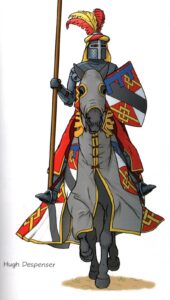
Many tournaments were held in Dunstable, including mêlées which were huge mock battles. The tournament of 1309, held at around Easter time, is famous because the names of the knights who took part are recorded on a manuscript with detailed descriptions of their coats of arms. Great retinues of knights were led by various Earls. They came with their servants and followers from all over the country. Approximately 2,500 people arrived with 3,000 horses. Local people also enjoyed the spectacle, watching from the surrounding hills.
Illustration by Robin Davies – Hugh Despenser, part of the retinue of the Earl of Warwick (from ‘Dunstable Tournaments’ by John Buckledee)
Catherine and Henry had no living sons, and the King was worried about the succession, but the Pope refused to grant a divorce. Henry had secretly married Anne Boleyn in November 1532, followed by a formal ceremony in January 1533, after which Henry was excommunicated. A law was passed to prevent the Pope from interfering, allowing Henry complete control of English church matters. A court was set up in the Lady Chapel in Dunstable’s Augustinian Priory. Between 10th – 23rd May this Court of Annulment met to decide ‘the King’s grete and weightie matter’ and his marriage to Catherine was declared void. His marriage to Anne Boleyn was then declared legal by the Archbishop of Canterbury.
Illustration by Tony Woodhouse – The Court of Annulment (from ‘Dunstable – a Visual History’ by Tony Woodhouse)

On 31st December 1539, Gervase Markham, the last Prior of the Augustinian Priory, formally surrendered to the King’s Commissioners. This act was part of King Henry VIII’s wider campaign to dissolve the monasteries, following his establishment as Head of the Church of England. In the year that followed, the Priory’s altar plate and vestments were sent to the Tower of London, while the lead from the roof was taken to the Tower foundry. Stone and other building materials were either pilfered, sold off, or re-used in local buildings.
The nave, which had long served as the Parish Church, had been traditionally maintained by the townsfolk, who also took on responsibility for the upkeep of the roof. The Church was ultimately saved from complete destruction and was later given to the people of Dunstable.
Illustration by Tony Woodhouse – Demolition of the Priory (from ‘Dunstable – a Visual History’ by Tony Woodhouse)

In June 1644 Royalist cavalry raided Dunstable in search of horses, killing the landlord of the Red Lion Inn on the corner of Church Street. Dunstable was strongly non–conformist, they they did not agree with the Church of England, and on hearing that there was a service being held in the Priory Church which did not conform to the Book of Common Prayer, the Royalist cavalry stormed the church, firing at the Priory door, shooting at the Rector in the pulpit and wounding members of the congregation. The door with bullet holes can still be seen in the church.
Illustration by Tony Woodhouse – Royalist Cavalry attack the Priory Church

Robert Munt and Thomas Brown of Wood Street, London, were the first London straw hat manufacturers to establish a branch in Dunstable. In about 1833 they leased Priory House, which they later bought in 1859, using it as the manager’s residence. A three-storey extension was added and used as the factory. In their heyday in 1864 they employed 350 women and 40 men and were the largest firm in the town.
However, the boom times ended when fashions changed and by 1908 the last owner of the firm, Henry Brown, was unable to continue trading due to financial difficulties and the business went into liquidation.
Illustration: Munt and Brown Manufactory (Crossroads book, originally Dunstaplelogia)
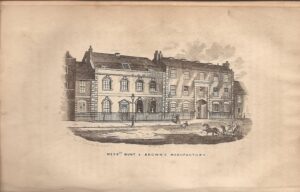
In the 1940s there were discussions about providing a public garden around the church and churchyard. In 1946 the Ministry of Town and Country Planning recommended using the Priory House Garden as a public open space and the local authority compulsorily purchased Priory House and the land with the aid of a loan from the Ministry of Health. A small garden was left for the tenants of Priory House.
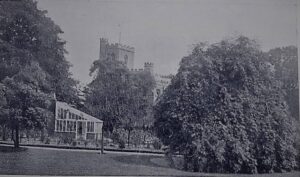
The new public area included a fountain, lily pond, statuette, greenhouse and vegetable garden. New paths were laid and areas replanted. The gardens were officially opened to the public by the Mayor on 24th May 1947.
Photo by J. Field – Weeping Ash and Greenhouse
In June 1947 the War Memorial Committee requested that an area in Priory Gardens be set aside for the provision of a war memorial and a section of the orchard area was allocated.
Funded by public subscription, the war memorial was dedicated on 13th May 1952, with the Mayor, Alderman Tommy Sandland, leading the ceremony. The two bronze plaques containing the names of the fallen were donated by the Rotary Clubs of Dunstable and Menin in Belgium.
In 2018 the memorial was refurbished, and any missing names were added to the plaques.
Photo: Dedication Ceremony

In 1213 the building of the Augustinian Priory was finally complete, having taken eighty years. On 18th October, the feast day of St Luke, it was dedicated to St Peter by Bishop Hugh II of Lincoln. The event was attended by earls, barons, priors, nobles and many ordinary people.
Throughout 2013 Dunstable celebrated everything medieval to mark the 800th anniversary of the dedication of the Priory. Celebrations to mark the anniversary included the design and installation of a Medieval Physic Garden, ‘Hidden Priory’ guided walks, concerts, themed Teatime Tales, a Festival of Archaeology, and the publication of the book, ‘Medieval Dunstable’.
Photo: A Festival of Dedication Eucharist was held in Priory Church on 18th October 2013. Kindly provided by Jean Yates

Dunstable’s Priory Gardens, which form part of a Scheduled Ancient Monument, were awarded the coveted Green Heritage Site status in 2020. Dunstable Town Council is proud of its local heritage and this award recognises the Council’s commitment to celebrating its history. The gardens are in the historic centre of Dunstable, with strong associations with Henry VIII. They are attractive and well maintained and are situated adjacent to Priory Church and Priory House, both listed buildings.
Green Heritage Site Accreditation, supported by Historic England, is given in recognition of achieving the required standard in the management and interpretation of a site with local or national historic importance. To receive Green Heritage Site Accreditation, sites must also achieve the Green Flag Award, an award which recognises and rewards the best green spaces in the country.
Illustration: Green Heritage Plaque

Medieval Priory Gateway
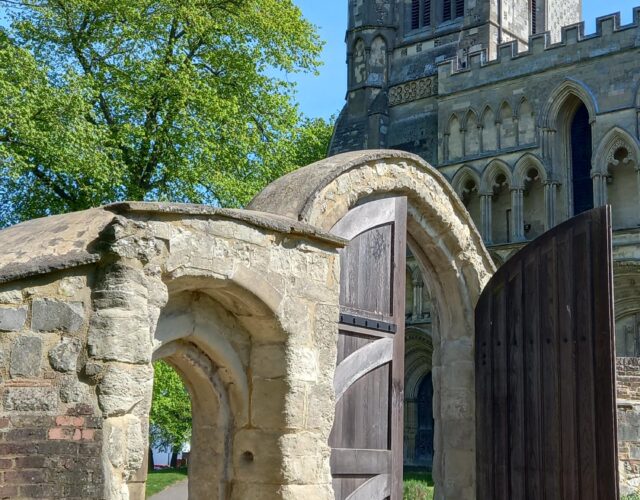
The Medieval Priory Gateway in Dunstable is a remarkable surviving fragment of the once-great Augustinian Priory of St Peter, founded in the early 12th century. This historic structure, located near Priory House and Gardens, served as the main entrance to the monastic complex and stands today as a striking reminder of the town’s medieval heritage. With its weathered stonework and impressive arched entrance, the gateway offers a glimpse into the architectural craftsmanship of the period. It remains one of the few intact features of the original priory, connecting visitors to Dunstable’s rich ecclesiastical history and providing a dramatic backdrop to the surrounding landscape.
The gardens can easily be accessed via High Street South, Priory Road, and Church Street, either on foot or by bicycle. Bus stops are situated along High Street South and Church Street. A pay-and-display car park is available on Church Street and Ashton Square.
33 High Street South
Dunstable, LU6 3RZ